
How Large Language Models Like ChatGPT Generate Text
AI doesn’t write by thinking like a human
Large language models such as ChatGPT can answer questions, write stories, summarize articles, translate languages, and even help with coding. Because the responses often sound natural, it’s easy to imagine that the AI is thinking, reasoning, or understanding language in the same way people do.
What’s actually happening is different.
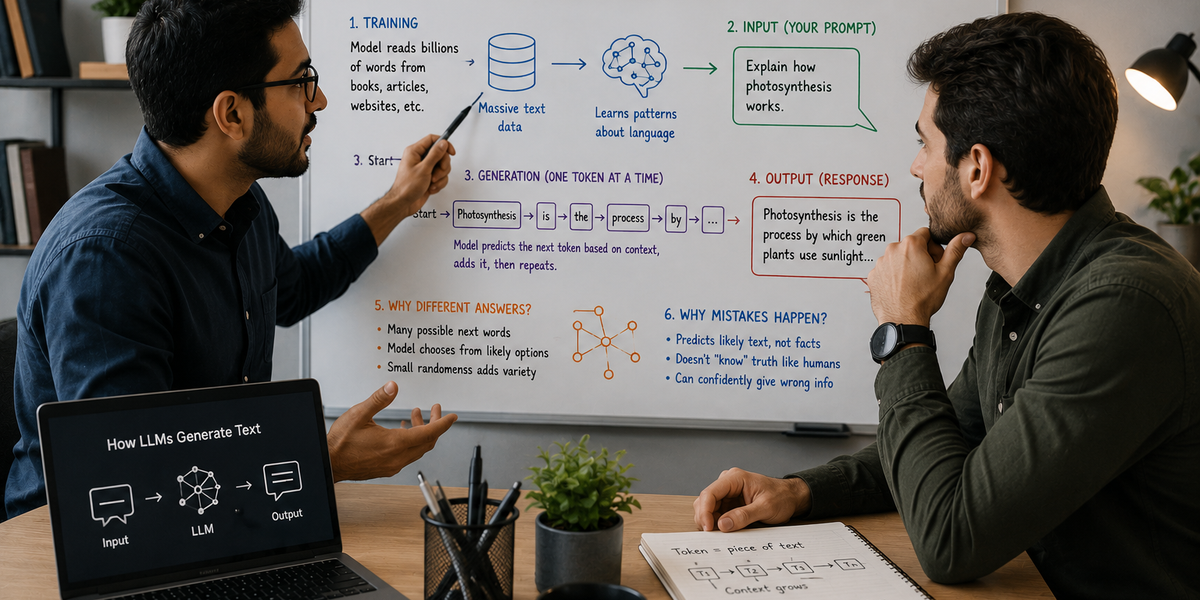
Large language models generate text by recognizing patterns they learned during training. Rather than searching for pre-written answers or copying information from a database, they predict what words are most likely to come next based on the prompt they receive and everything they’ve learned from vast amounts of text.
While the technology behind this process is highly sophisticated, the basic idea is surprisingly simple.
It all starts with learning from enormous amounts of text
Before a language model can answer questions, it goes through a lengthy training process.
During training, the model analyzes an enormous collection of books, articles, websites, conversations, and other written material. Instead of memorizing every sentence, it learns patterns about how words, phrases, and ideas relate to one another.
For example, it learns that certain words frequently appear together, that sentences usually follow recognizable structures, and that different writing styles have their own patterns.
Over time, the model develops a statistical understanding of language. It becomes very good at predicting what word is likely to follow another in countless different contexts.
This pattern recognition forms the foundation of everything a language model does.
Every response is built one word at a time
When you type a prompt into ChatGPT, the model doesn’t instantly produce an entire paragraph.
Instead, it generates the response step by step.
First, it analyzes your prompt to understand the context. It then predicts the most appropriate next word—or more accurately, the next small piece of text called a token. Once that token is generated, it becomes part of the context for predicting the next one.
This process repeats rapidly, hundreds or even thousands of times, until the complete response is produced.
Although it happens almost instantly, every sentence is created through this sequence of predictions.
You can think of it as an incredibly advanced autocomplete system that continually predicts the next piece of text based on everything that has come before.
Why the same question can produce different answers
Unlike a calculator, language models aren’t designed to return exactly the same response every time.
There are often many equally valid ways to answer a question, explain an idea, or tell a story. Because of this, the model has some flexibility in choosing between several likely next words instead of always selecting the exact same one.
That’s why asking the same question twice may produce responses with different wording while still conveying the same overall meaning.
This flexibility also allows AI to adapt its writing style. It can explain a scientific topic in simple language, write a formal business email, create a poem, or tell a joke—all by adjusting its predictions based on the context and instructions it receives.
The underlying process remains the same regardless of the writing style.
Why language models sometimes make mistakes
Despite their impressive capabilities, large language models aren’t perfect.
They don’t automatically know whether every statement they generate is factually correct. Their primary goal is to produce text that fits the patterns they’ve learned and makes sense in the context of the conversation.
Most of the time, this produces accurate and helpful responses. Occasionally, however, the model may generate incorrect information, misunderstand a question, or confidently state something that isn’t true.
These errors happen because the model predicts likely language rather than verifying every fact independently.
For everyday questions, language models are often highly useful. But for medical advice, legal matters, financial decisions, or other high-stakes topics, it’s important to verify important information using reliable sources.
Language models are becoming part of everyday life
Large language models now power much more than chatbots.
They’re used to draft emails, summarize documents, assist programmers, translate languages, generate marketing content, answer customer service questions, support education, and help businesses automate routine tasks.
Many search engines, productivity tools, and smartphone features now incorporate language models behind the scenes.
As these systems continue to improve, they’ll increasingly become everyday assistants that help people work more efficiently, communicate more clearly, and access information more quickly.
In many cases, people will benefit from language models without even realizing they’re interacting with one.
Understanding how language models work makes them easier to use
You don’t need a background in computer science to understand the basic idea behind large language models.
At their core, they learn patterns from enormous amounts of text and generate responses by predicting one piece of language at a time. They’re remarkably capable because they’ve been trained on vast amounts of written information and can apply those patterns across an extraordinary range of topics.
At the same time, they don’t think, feel, or understand the world like humans do. They can make mistakes, misunderstand context, and occasionally produce inaccurate information.
Knowing both their strengths and limitations helps you use tools like ChatGPT more effectively. The better you understand how they generate text, the easier it becomes to ask better questions, interpret their responses, and decide when human judgment is still essential.