How the Internet Actually Works (Explained Simply)
The internet is more like a giant postal system than a cloud
The internet often feels like magic. You type a website into your browser, tap Enter, and within seconds you’re watching videos, reading news, or chatting with someone on the other side of the world. Because it all happens so quickly, it’s easy to imagine the internet as an invisible “cloud” where everything simply exists.
In reality, the internet is a massive network of billions of devices connected by cables, satellites, routers, and data centers. Every computer, smartphone, tablet, gaming console, and smart TV connected to the internet becomes part of this enormous network.
A useful way to think about the internet is as an international postal service. Instead of sending letters, it sends tiny pieces of digital information called data. Whether you’re streaming a movie, sending an email, or posting a photo, your information travels across this network in much the same way a package moves through postal offices before arriving at its destination.
The difference is speed. Instead of taking days, most internet data reaches its destination in fractions of a second.
What happens when you visit a website?
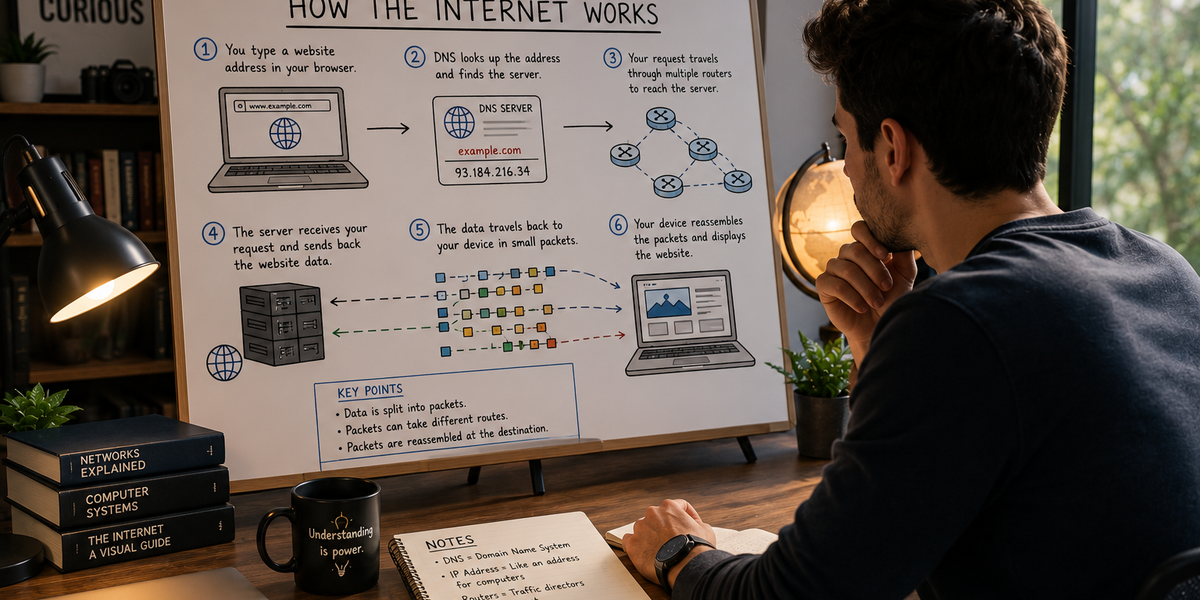
Imagine you type “www.example.com” into your browser.
Your device doesn’t instantly know where that website lives. First, it asks a system called the Domain Name System (DNS), which works much like the contact list on your phone. Instead of remembering long numerical addresses called IP addresses, you simply remember names like Google.com or Wikipedia.org. DNS translates those familiar names into the numerical addresses computers use to communicate.
Once your browser finds the correct address, it sends a request across the internet asking for the website.
That request travels through multiple routers, which act like traffic directors. Each router examines the destination and decides the fastest available route for your data to continue its journey. Depending on network traffic, maintenance, or outages, your request may take a different route each time, even when visiting the same website.
The website’s server then receives your request. A server is simply a computer that stores websites and is designed to respond to visitors around the clock.
The server sends back everything needed to display the page—text, images, videos, buttons, and code. Your browser assembles all these pieces and displays the finished website, often in less than a second.
Why data travels in tiny packets
One surprising fact about the internet is that information isn’t sent as one large file.
Instead, everything is divided into tiny pieces called packets.
Imagine mailing a 500-page book. Rather than placing the entire book in one oversized package, you separate it into hundreds of small envelopes, each numbered in order. These envelopes can travel through different postal routes and still arrive at the same destination, where they’re reassembled into the complete book.
Internet packets work the same way.
A single video, photo, or webpage may consist of thousands of packets. Each packet contains a small amount of data along with information about where it came from and where it’s going.
Some packets may arrive before others, and they don’t always follow identical routes. Your device automatically puts them back together in the correct order. If a packet gets lost along the way, it can simply be requested again instead of retransmitting the entire file.
This packet-based design makes the internet faster, more efficient, and remarkably resilient.
Where websites and apps actually live
Many people imagine websites floating somewhere “in the cloud.”
The cloud isn’t a magical place—it’s simply someone else’s computers.
Companies operate enormous data centers filled with thousands of servers that store websites, apps, photos, videos, emails, and business software. These facilities are located all over the world and are connected by high-speed fiber-optic cables.
When you watch a streaming service, upload photos to cloud storage, or save documents online, your files are being stored on physical computers inside one or more of these data centers.
Large companies often keep copies of popular content in multiple locations worldwide. This means someone in Germany may receive data from a nearby server rather than one located in the United States, reducing delays and making websites feel much faster.
This system also improves reliability. If one server or data center experiences problems, another can often continue serving users with little or no interruption.
Why the internet feels so fast
Modern internet speeds are possible because millions of network devices work together continuously.
Fiber-optic cables carry enormous amounts of data using pulses of light. These cables run beneath roads, across countries, and even along the ocean floor, connecting continents with incredible speed.
Routers constantly choose efficient paths for traffic, while internet service providers manage the infrastructure that connects homes and businesses to the wider internet.
Browsers also help by storing copies of frequently used files in a cache. If you’ve recently visited a website, your browser may already have some of its images or design files saved locally, allowing the page to load more quickly the next time.
Content delivery networks (CDNs) also speed things up by placing copies of popular websites, videos, and images on servers closer to users. Instead of downloading a file from the opposite side of the world, your device often retrieves it from a nearby location.
All of these technologies combine to make the internet feel nearly instantaneous, even though your data may travel hundreds or thousands of miles.
The internet is one of humanity’s biggest engineering achievements
Although we use it every day, the internet is an astonishing piece of engineering. It connects billions of devices across almost every country on Earth using shared rules that allow different manufacturers, operating systems, and networks to communicate seamlessly.
Every search, video call, online purchase, social media post, or streamed movie depends on countless computers cooperating behind the scenes. Requests are routed across global networks, broken into packets, reassembled at their destination, and delivered in moments—all without users noticing the extraordinary complexity involved.
The next time you open a website, remember that you’re not simply pulling information from a mysterious cloud. You’re sending a request through a vast global network of cables, routers, servers, and data centers that work together to deliver information almost instantly.
It’s not magic—it’s one of the most impressive technological systems ever built.