
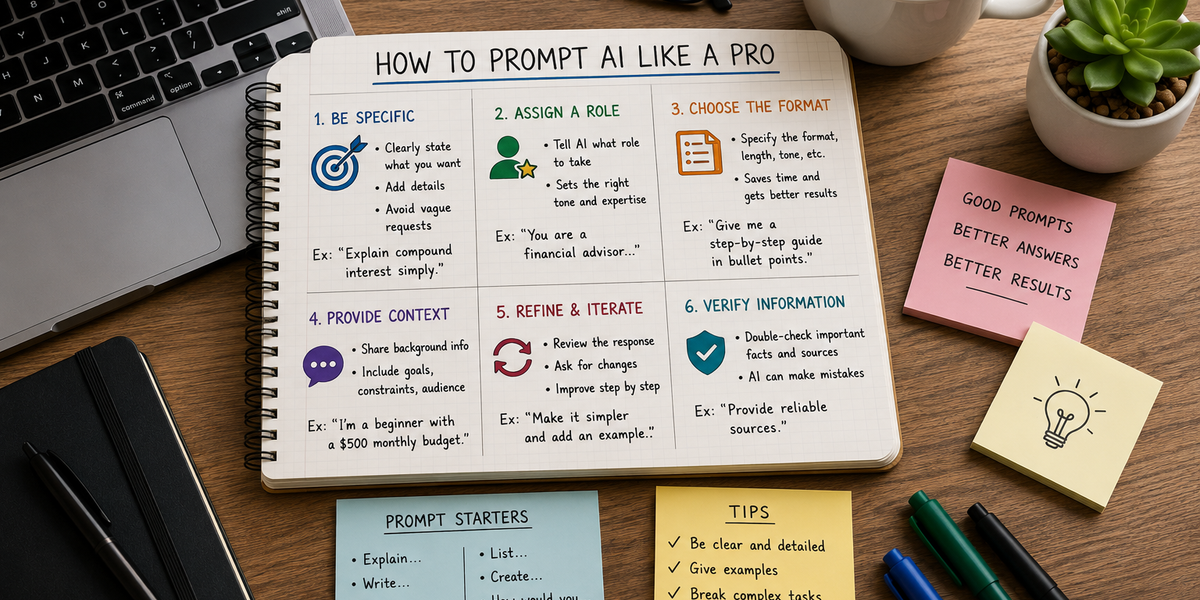
How to Prompt AI Like a Pro
The quality of AI’s answers depends largely on your questions
Many people expect artificial intelligence to understand exactly what they mean after typing just a few words. Sometimes it works. Other times, the response is vague, incomplete, or simply not what they were looking for.
The difference often comes down to the prompt.
A prompt is simply the instruction or question you give an AI system. The clearer and more detailed your prompt is, the more useful the response is likely to be. Learning how to write better prompts doesn’t require technical knowledge—it simply means communicating your goal more effectively.
Think of AI like a highly capable assistant. The more context you provide, the better it can help.
Be specific about what you want
One of the biggest mistakes people make is being too vague.
Instead of asking, “Tell me about investing,” try asking, “Explain index fund investing for someone with no financial background in under 500 words.”
Rather than saying, “Write an email,” explain who it’s for, the purpose of the message, and the tone you want. If you’re planning a trip, include your destination, budget, travel dates, and interests instead of simply asking for recommendations.
The more relevant details you provide, the fewer assumptions the AI has to make.
Specific prompts usually lead to more accurate, practical, and personalized answers.
Tell the AI what role to take
One simple technique that often improves responses is assigning the AI a role.
For example, you might ask it to explain something like a teacher, review a document like an editor, think through a business problem like a consultant, or simplify a technical topic for a beginner.
Giving the AI a role helps establish the perspective and style you want before it starts generating a response.
You can also specify the audience. Ask for an explanation suitable for a child, a university student, a customer, or an experienced professional depending on your needs.
This small addition often makes the output much more useful.
Describe the format you want
AI can produce information in many different formats, but it won’t automatically know which one you prefer.
If you want a step-by-step guide, ask for one. If you’d rather receive a table comparing options, say so. You can request a checklist, summary, action plan, timeline, email, presentation outline, or social media post.
Length matters too. Mention whether you want a brief explanation, a detailed article, or something in between.
The clearer your expectations, the less time you’ll spend editing or asking follow-up questions.
A few extra words in your prompt can save much more time later.
Refine the conversation instead of starting over
One advantage of AI is that conversations can evolve.
If the first response isn’t exactly what you wanted, you don’t need to write a completely new prompt. Instead, build on what’s already there.
You can ask the AI to make the explanation simpler, shorten the response, add examples, change the tone, expand a specific section, or focus on a different audience.
Treat the interaction like working with a colleague. The first draft doesn’t have to be perfect. Giving feedback usually produces better results than starting from scratch every time.
This back-and-forth process often leads to stronger answers with much less effort.
Verify important information
AI is a powerful tool, but it isn’t perfect.
While it often provides accurate and helpful responses, it can occasionally misunderstand a question, omit important details, or confidently present incorrect information.
That’s why it’s a good idea to verify information when making important decisions, especially in areas such as healthcare, finance, legal matters, or major business decisions.
Think of AI as a research assistant rather than the final authority. It can help organize ideas, explain concepts, and speed up your work, but your own judgment still matters.
The best results come from combining AI’s speed with human critical thinking.
Great prompts lead to great results
Using AI effectively isn’t about knowing secret commands or complicated techniques. It’s about asking clear, thoughtful questions that give the system enough context to understand your goal.
Be specific about what you need, describe the audience and format, provide relevant details, and don’t hesitate to refine the response through follow-up prompts.
The more you practice writing prompts, the more useful AI becomes. What starts as a simple question can quickly turn into a productive conversation that helps you learn faster, work more efficiently, and solve problems more creatively.
In the end, prompting isn’t really about talking to a machine—it’s about learning how to communicate your ideas clearly. And that’s a skill that remains valuable far beyond AI itself.