
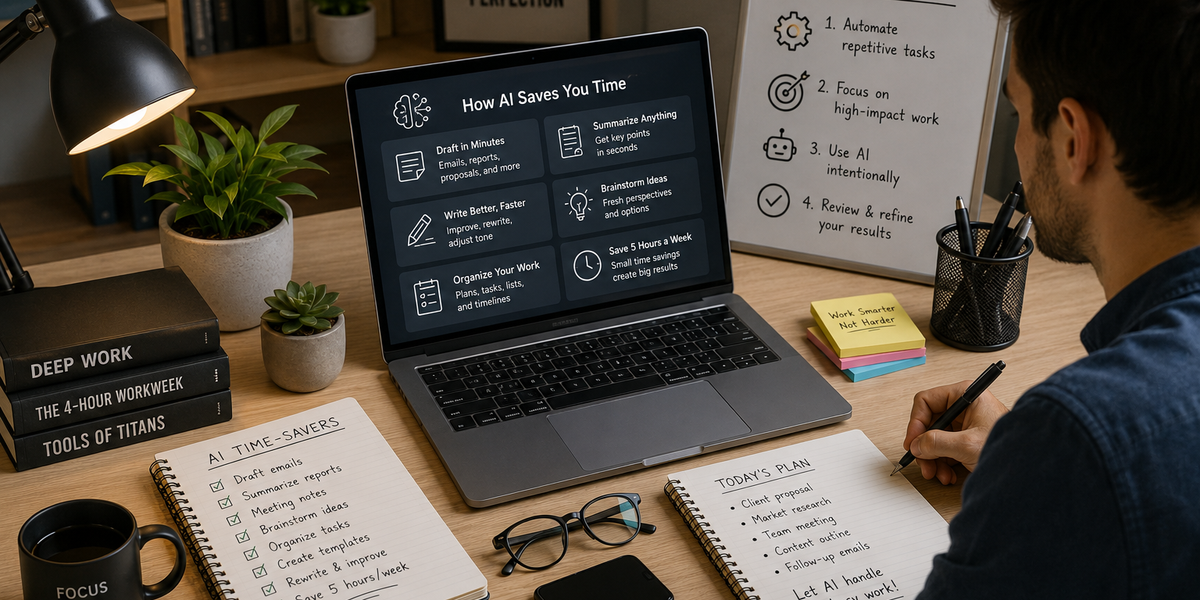
How to Use AI to Save 5 Hours a Week
AI is most valuable when it handles repetitive work
Artificial intelligence is often presented as a revolutionary technology that will transform every aspect of our lives. While AI is capable of impressive things, its biggest everyday benefit is much simpler: it saves time.
Many of the tasks that fill our workdays—writing emails, summarizing documents, organizing information, brainstorming ideas, or formatting text—are repetitive rather than difficult. AI excels at these kinds of jobs, allowing you to focus your energy on work that requires creativity, judgment, or personal interaction.
You don’t need to automate your entire life to benefit from AI. Saving just 45 minutes a day adds up to roughly five hours every week.
Let AI handle your first draft
One of the biggest time-savers is using AI to overcome the blank page.
Instead of staring at an empty document, ask AI to create a first draft of an email, report, presentation outline, meeting agenda, blog post, or proposal. You don’t have to use the draft exactly as it’s written. Think of it as a starting point that you can edit, personalize, and improve.
Creating something from scratch usually takes much longer than refining an existing draft.
This approach is especially useful for routine communication, recurring reports, or documents that follow a familiar structure.
Summarize instead of reading everything
Modern professionals are overwhelmed by information.
Long reports, research papers, meeting transcripts, newsletters, and policy documents can consume hours each week.
AI can quickly summarize lengthy material, highlight the main points, identify action items, or explain complex topics in simpler language. Instead of reading every page in detail, you can review the summary first and then decide which sections deserve a closer look.
This doesn’t mean you should skip important documents entirely—especially contracts, legal agreements, or technical material—but summaries can dramatically reduce the time spent sorting through information.
Often, understanding the key ideas is all you need.
Automate everyday writing tasks
Writing is part of almost every job, even if you’re not a professional writer.
AI can help draft emails, improve grammar, rewrite text in a different tone, create meeting notes, prepare social media posts, generate job descriptions, or organize scattered notes into clear paragraphs.
It can also adjust the style of your writing depending on the audience. The same information can be rewritten as a formal business email, a friendly message, or a concise executive summary in just a few seconds.
Rather than replacing your voice, AI allows you to spend more time refining ideas and less time worrying about wording.
Use AI as a brainstorming partner
Not every problem has an obvious solution.
When you’re planning a project, organizing an event, naming a product, solving a business challenge, or preparing a presentation, AI can generate ideas surprisingly quickly.
It won’t always produce the perfect answer, but it can offer perspectives you might not have considered or help you explore multiple options without hours of research.
This makes AI particularly useful during the early stages of creative work, when generating possibilities is often more important than finding the final answer immediately.
You remain the decision-maker, but AI can significantly speed up the thinking process.
Organize your work more efficiently
Many people lose time not because they’re working slowly, but because their work is disorganized.
AI can help create project plans, break large goals into manageable steps, prioritize task lists, prepare meeting agendas, generate checklists, and even suggest timelines for completing complex projects.
Instead of spending thirty minutes deciding where to begin, you can ask AI to organize your workload into a practical action plan.
This kind of assistance reduces decision fatigue and helps you move from planning to action more quickly.
Small improvements in organization often save more time than working faster.
Remember that AI works best with human judgment
Although AI can dramatically improve productivity, it isn’t a substitute for experience, expertise, or critical thinking.
Important business decisions, legal documents, financial planning, healthcare information, and sensitive communications should always be reviewed carefully. AI can make mistakes, misunderstand context, or overlook important details.
The best approach is to let AI handle repetitive or time-consuming tasks while you focus on reviewing, improving, and making final decisions.
Think of AI as an assistant, not a replacement.
Small time savings create big results
Saving five hours a week doesn’t require dramatic changes. It comes from improving dozens of small tasks that quietly consume your day.
Drafting emails in minutes instead of half an hour. Summarizing reports before reading them in full. Brainstorming ideas more quickly. Organizing projects with less effort. Turning rough notes into polished documents without starting from scratch.
Individually, these improvements may seem small. Together, they can free up an entire workday every month.
The real value of AI isn’t simply working faster—it’s spending more of your time on the work that truly benefits from your creativity, expertise, and judgment.