The Ideas That Sounded Crazy and Turned Out Right
Many of history’s greatest ideas were once dismissed
Almost every major breakthrough begins as an idea that seems unrealistic.
When a new concept challenges the way people have always done things, skepticism is a natural response. Sometimes those doubts are justified. But throughout history, many ideas that were mocked, ignored, or considered impossible eventually transformed the world.
The lesson isn’t that every unconventional idea is destined to succeed. It’s that truly innovative thinking often looks unusual before its value becomes obvious.
Progress depends on people who are willing to question assumptions and imagine possibilities that others struggle to see.
Flying once seemed impossible
For centuries, the idea of humans flying through the sky belonged more to myths and dreams than to science.
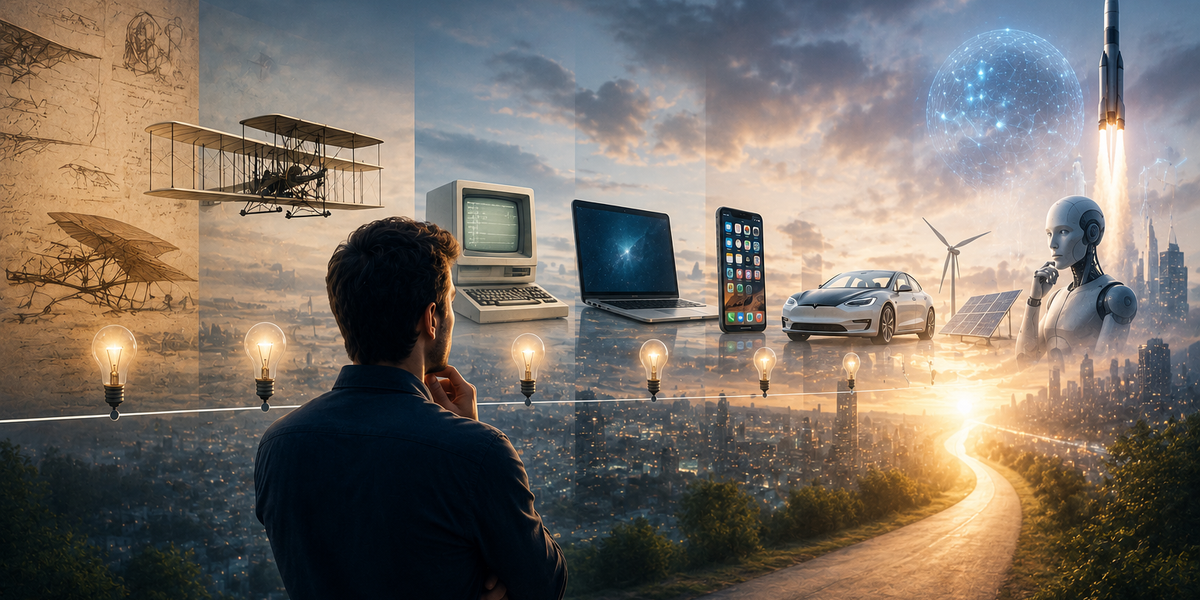
Many believed powered flight would never become practical. Yet through years of experimentation, engineering, and countless failures, pioneers eventually proved that controlled flight was possible.
Today, air travel is so common that millions of people board airplanes every day without giving it much thought.
What once seemed impossible has become one of the foundations of the global economy, connecting countries, businesses, and families around the world.
The internet was once considered a niche technology
When the internet began expanding beyond research institutions, few people predicted how completely it would reshape everyday life.
Some viewed it as a tool mainly for academics or technology enthusiasts. Others questioned whether people would ever feel comfortable shopping, banking, or working online.
Today, the internet influences nearly every aspect of modern life.
Communication, education, entertainment, healthcare, business, and government services have all been transformed by a technology that many initially underestimated.
Its success came not from replacing every existing system overnight, but from gradually becoming useful in more areas of daily life.
Smartphones replaced dozens of separate devices
The idea of carrying a powerful computer in your pocket once sounded unnecessary to many people.
Early mobile phones were designed primarily for calls and text messages. Combining cameras, internet access, navigation, music, photography, and thousands of applications into one device seemed excessive to some observers.
Today, smartphones have become one of the most widely used technologies in history.
They’ve replaced maps, calculators, alarm clocks, flashlights, cameras, music players, calendars, and countless other standalone devices.
What initially appeared to be an ambitious idea is now an essential tool for billions of people.
Many breakthroughs succeed because technology catches up
Sometimes an idea isn’t wrong—it simply arrives before the world is ready for it.
Throughout history, inventors have proposed concepts that couldn’t succeed because the necessary materials, computing power, infrastructure, or manufacturing techniques didn’t yet exist.
Years later, advances in technology allowed those same ideas to flourish.
Electric vehicles, for example, have existed for more than a century, but improvements in battery technology, software, and charging infrastructure have made them far more practical today than they were in the past.
Timing can be just as important as the idea itself.
Bold ideas still require evidence
It’s tempting to assume that every unconventional idea deserves support simply because it’s different.
In reality, successful breakthroughs aren’t driven by optimism alone.
The people behind them usually spend years testing assumptions, gathering evidence, refining designs, and learning from failure. They improve their ideas through experimentation rather than relying solely on confidence.
Many bold ideas fail because they don’t solve meaningful problems or because they never work as intended.
The ideas that eventually succeed are those that combine imagination with persistence, careful testing, and a willingness to adapt.
Today’s impossible ideas may become tomorrow’s reality
Right now, researchers and entrepreneurs are exploring technologies that still seem futuristic to many people.
Artificial intelligence is reshaping industries. Scientists are developing cleaner energy systems, more advanced medical treatments, reusable rockets, autonomous machines, and new ways to produce food.
Some of these ideas will never become mainstream. Others may reshape society in ways that are difficult to predict.
History suggests that it’s wise to keep an open mind while remaining grounded in evidence.
The future is rarely built by accepting things exactly as they are.
Innovation begins with the courage to imagine differently
Looking back, many of history’s greatest achievements share something in common: they seemed unlikely before they became obvious.
People doubted that humans would fly, that computers would fit in our homes, or that billions of people would carry internet-connected devices in their pockets. Yet each of these ideas eventually became part of everyday life.
Not every unusual idea will change the world, and skepticism has an important role in separating promising concepts from unrealistic ones. But history also reminds us that progress often begins with someone willing to ask, “What if?”
The ideas that sound impossible today may become the ordinary realities of tomorrow—not because they were accepted immediately, but because someone kept improving them until the rest of the world could finally see what was possible.