The Inventions That Changed How We Live
The biggest inventions often become the easiest to take for granted
Every day, we flip a light switch, unlock our phones, travel across cities, and connect with people on the other side of the world without giving much thought to the inventions that make these moments possible.
Many of the technologies we now consider ordinary were once revolutionary. They didn’t just introduce new products—they transformed the way people worked, communicated, traveled, learned, and lived.
Some inventions solved obvious problems, while others created entirely new possibilities that previous generations could hardly imagine.
Looking back at these breakthroughs reminds us just how dramatically human life has changed in a relatively short period of history.
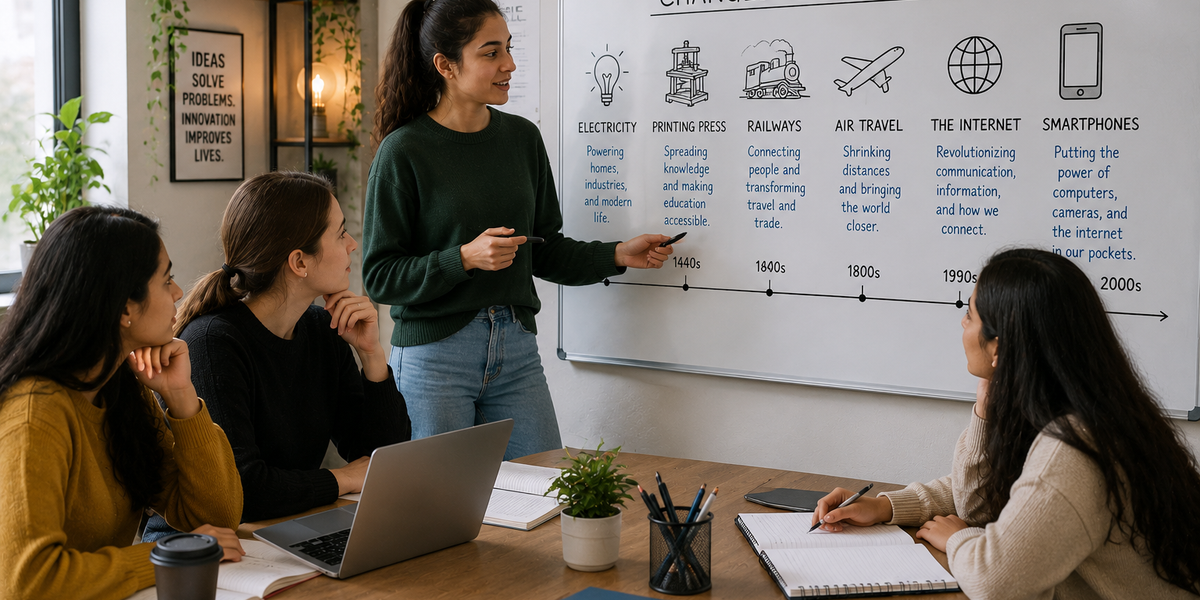
Electricity transformed almost every aspect of modern life
It’s difficult to imagine modern civilization without electricity.
Before widespread electrical power, homes relied on candles and oil lamps for light, factories were far less efficient, and everyday tasks often required far more physical effort.
Electricity became the foundation for countless later inventions, from refrigerators and washing machines to computers, medical equipment, and the internet itself.
Today, nearly every part of modern society depends on reliable electrical power. Hospitals, transportation systems, communications networks, and businesses all rely on it to function.
Rather than being just another invention, electricity became the platform upon which many of the world’s greatest innovations were built.
The printing press made knowledge accessible
Before the invention of the printing press, books had to be copied by hand.
This made them expensive, rare, and available to only a small portion of the population. The printing press changed that by allowing books and written materials to be reproduced much more quickly and affordably.
As literacy spread, ideas could travel across countries and generations with unprecedented speed.
Scientific discoveries, political movements, educational materials, and literary works became available to millions rather than a privileged few.
The ability to share knowledge at scale helped fuel the Renaissance, the Scientific Revolution, and many of the educational systems we know today.
Transportation shrank the world
For most of human history, traveling long distances was slow, difficult, and often dangerous.
The development of railways, automobiles, and airplanes dramatically changed that reality.
People could move between cities in hours instead of days and cross continents in a matter of hours rather than weeks. Businesses expanded beyond local markets, tourism became accessible to millions, and families separated by great distances could visit one another far more easily.
Transportation didn’t simply make travel faster—it reshaped economies, cultures, and international relationships by connecting people in ways that had never before been possible.
Today, global trade and modern supply chains depend heavily on these innovations.
The internet changed communication forever
Few inventions have transformed daily life as rapidly as the internet.
Within just a few decades, it changed how people communicate, shop, learn, work, and entertain themselves.
Information that once required hours of research in a library can now be accessed in seconds. Families separated by thousands of miles can video chat instantly. Businesses can collaborate across continents, while students have access to educational resources from around the world.
The internet also created entirely new industries, careers, and forms of communication that didn’t exist a generation ago.
Like the printing press centuries earlier, it dramatically increased access to knowledge—but at a speed and scale unlike anything in human history.
Smartphones put countless inventions into one device
Not long ago, people carried separate devices for making calls, taking photographs, listening to music, reading maps, checking the weather, using a calculator, and accessing the internet.
Today, smartphones combine all of those functions—and many more—into a device that fits in a pocket.
They’ve become cameras, navigation systems, wallets, libraries, entertainment centers, translators, health trackers, and communication tools all at once.
This level of integration has fundamentally changed how people organize their lives, conduct business, and stay connected.
For many people, the smartphone isn’t just another invention. It’s the gateway through which they access much of the modern world.
Every breakthrough creates the foundation for the next
One of the most fascinating things about innovation is that inventions rarely exist in isolation.
Electricity made computers possible. Computers enabled the internet. The internet accelerated artificial intelligence. Advances in materials science improved transportation, medicine, and renewable energy.
Each breakthrough builds on countless discoveries that came before it.
This chain of innovation explains why technological progress often appears to accelerate over time. New inventions don’t start from scratch—they stand on the foundations created by previous generations.
As a result, today’s innovations may become the building blocks for technologies that seem unimaginable today.
Tomorrow’s everyday life is being invented today
History shows that the inventions with the greatest impact aren’t always the ones people expect.
Many technologies that initially seemed like curiosities eventually transformed entire societies. Others quietly improved daily life without attracting much attention.
Today, artificial intelligence, renewable energy, advanced robotics, biotechnology, and quantum computing may represent the next wave of world-changing innovations.
While it’s impossible to predict exactly which technologies will have the greatest influence, one thing is certain: human progress has always been driven by curiosity, creativity, and the desire to solve problems.
The inventions we take for granted today were once bold ideas that seemed impossible. The breakthroughs shaping our future are likely beginning in much the same way.