
The Real Difference Between AI, Machine Learning, and Deep Learning
These terms are related—but they’re not the same thing
Artificial intelligence, machine learning, and deep learning are often used interchangeably. News articles, marketing campaigns, and even tech companies sometimes blur the lines between them, making it seem as though they all describe the same technology.
In reality, they’re different concepts that build on one another.
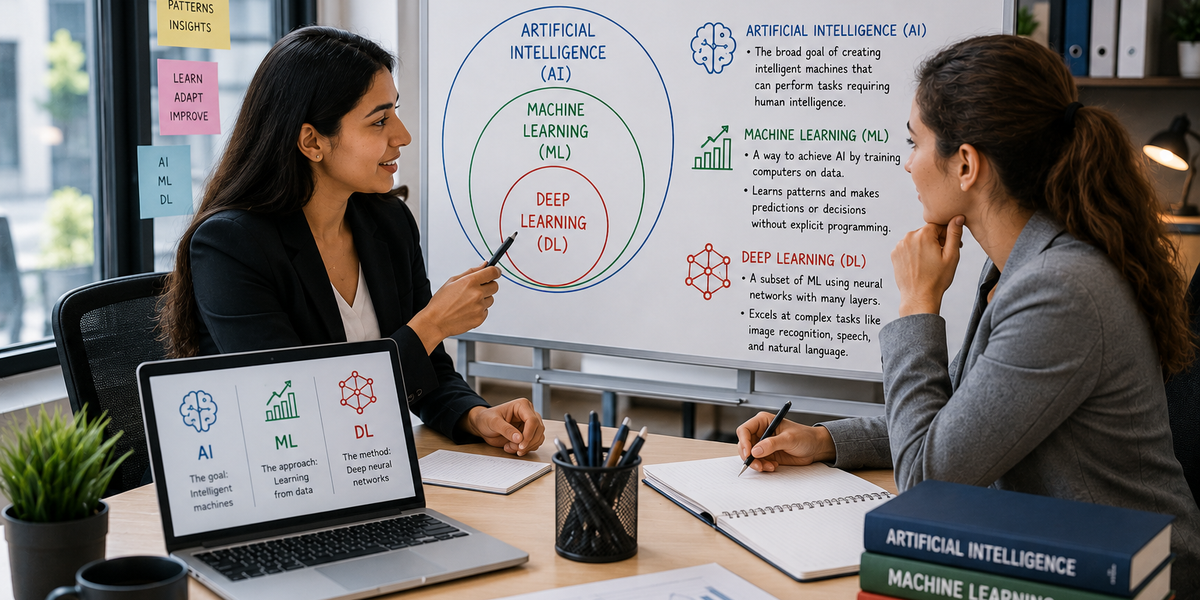
The easiest way to understand the relationship is to imagine three nested circles. Artificial intelligence is the largest category. Machine learning is one approach to building AI. Deep learning is a specialized type of machine learning that uses more complex neural networks.
Understanding these distinctions makes it much easier to follow conversations about modern technology and appreciate how today’s AI systems actually work.
Artificial intelligence is the broad goal
Artificial intelligence, or AI, refers to any computer system designed to perform tasks that normally require human intelligence.
These tasks include understanding language, recognizing images, solving problems, making recommendations, translating text, playing games, or helping drive vehicles.
Importantly, AI doesn’t describe a single technology. It’s an umbrella term that covers many different methods for making computers behave intelligently.
Some AI systems rely on carefully programmed rules. Others learn from large amounts of data. Some combine multiple techniques to accomplish complex tasks.
The goal remains the same: enabling machines to perform tasks that would otherwise require human decision-making or reasoning.
Machine learning teaches computers through experience
Machine learning is one of the most common ways to build modern AI systems.
Instead of programmers writing every rule by hand, machine learning allows computers to learn patterns from data.
Imagine you wanted a computer to identify whether an email is spam. Rather than creating thousands of rules describing every possible spam message, you could provide millions of examples of both spam and legitimate emails.
Over time, the computer learns which patterns commonly appear in spam and becomes increasingly accurate at identifying new emails it has never seen before.
This approach is useful because many real-world problems are simply too complex to solve with fixed rules.
Machine learning now powers recommendation systems, fraud detection, search engines, voice recognition, translation software, and countless other everyday technologies.
Deep learning takes machine learning further
Deep learning is a specialized branch of machine learning inspired by the structure of the human brain.
It uses artificial neural networks made up of many interconnected layers that process information step by step. Each layer identifies increasingly complex patterns, allowing the system to solve problems that would be difficult using simpler machine learning methods.
For example, when recognizing a face in a photograph, early layers may detect simple edges and colors. Later layers recognize shapes such as eyes or noses, while deeper layers combine those features to identify an entire face.
The same layered approach helps deep learning systems understand speech, generate realistic images, translate languages, and power many modern AI assistants.
Deep learning generally requires enormous amounts of data and significant computing power, but it has driven many of the biggest breakthroughs in artificial intelligence over the past decade.
Where you encounter these technologies every day
Even if you’ve never studied computer science, you probably use AI, machine learning, and deep learning every day.
Streaming platforms recommend movies based on your viewing habits. Online stores suggest products you might like. Email services filter spam before it reaches your inbox. Navigation apps estimate travel times and avoid traffic.
Many of these features rely on machine learning because they improve as they process more data.
Deep learning is especially common in applications involving images, speech, and natural language. Voice assistants understand spoken commands, smartphones recognize faces to unlock devices, translation apps convert languages in real time, and AI chatbots generate natural conversations using deep learning models.
Behind the scenes, these technologies often work together to create the experiences people now expect from modern software.
Why people often confuse the terms
The confusion largely comes from the rapid evolution of technology.
Artificial intelligence became a popular phrase decades before machine learning and deep learning reached today’s level of sophistication. As deep learning began producing remarkable results in language, image recognition, and content generation, many companies started describing everything simply as “AI.”
Technically, that’s not wrong—deep learning systems are a form of AI—but it hides the important differences between the technologies.
A helpful way to remember the relationship is this:
Artificial intelligence is the overall field of creating intelligent machines.
Machine learning is one method that allows computers to learn from data instead of following only hand-written rules.
Deep learning is an advanced form of machine learning that uses large neural networks to solve especially complex problems.
Understanding the differences helps you understand modern technology
As AI becomes part of more products and services, these terms will continue appearing in news headlines, workplaces, and everyday conversations.
You don’t need to understand advanced mathematics to follow along. Simply remembering that AI is the broad field, machine learning is one approach to achieving it, and deep learning is a specialized technique within machine learning provides a solid foundation.
Together, these technologies are transforming healthcare, education, transportation, finance, entertainment, and countless other industries. Understanding how they relate makes it easier to separate marketing buzzwords from the underlying technology—and to better appreciate the innovations shaping the future.